
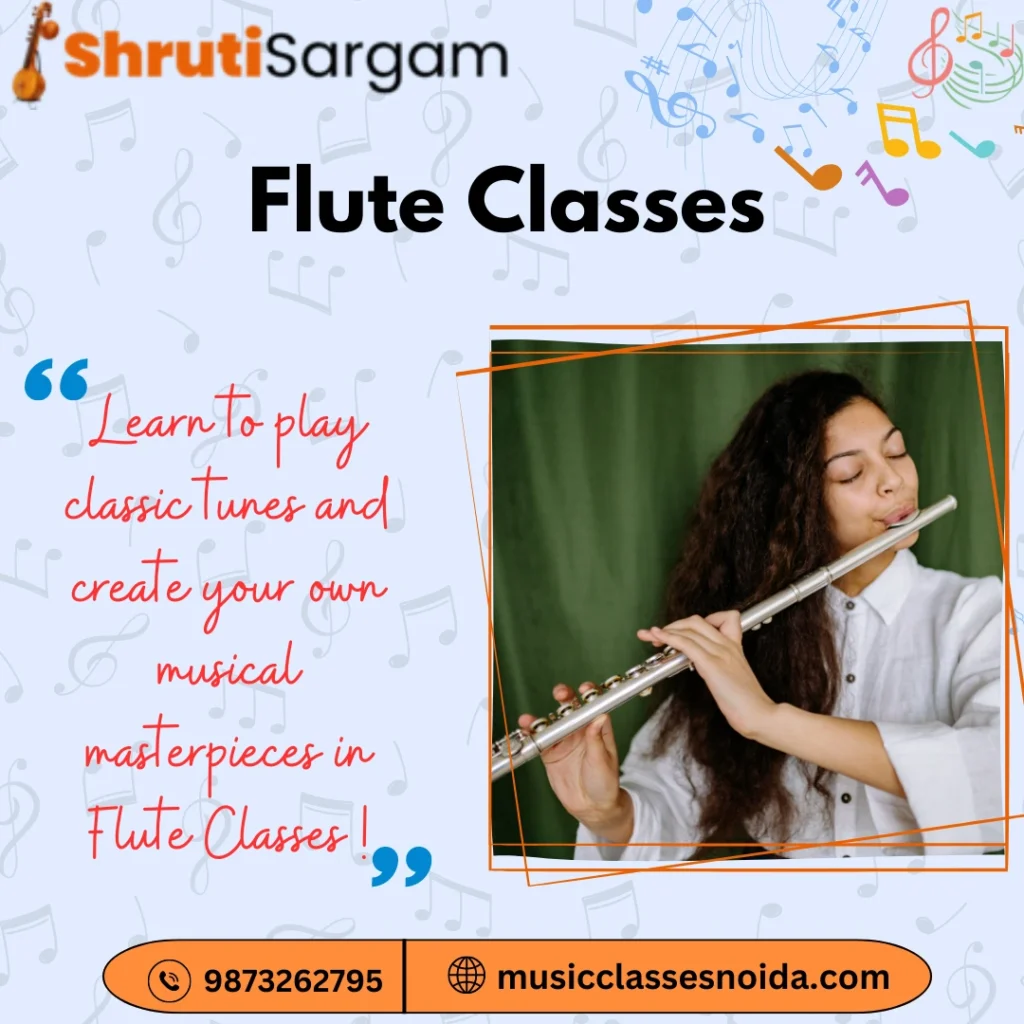
Flute classes in Noida are designed to teach students how to play the flute from the very basics. These classes cater to students of all ages, from complete beginners to experienced musicians looking to improve their skills.
Flute classes in Noida typically follow a structured syllabus that begins with the fundamentals and progresses to advanced techniques. The syllabus may differ depending on the student’s level, the type of flute being played (Western classical or Indian classical), and the teaching style of the teacher.
The following is a general outline of the curriculum for beginner flute classes:
Introduction to the flute: Students will learn about the flute’s parts as well as how to assemble and disassemble the instrument.
Posture and breathing: Students will learn proper flute posture and breathing techniques.
Embouchure: Students will learn how to form the correct lip position for playing the flute and producing a clear sound through embouchure.
Fingering: Students will learn how to finger basic notes on the flute as well as how to read sheet music.
Tone production: Students will learn how to produce a good tone on the flute as well as how to play basic melodies.
Scales and arpeggios: Scales and arpeggios: Students will be taught scales and arpeggios in a variety of keys.
Sight-reading: Students will learn to sight-read sheet music and play more complex melodies.
Etudes and exercises: Students will work on etudes and exercises to improve their technique and playing abilities.
Repertoire: Students will learn to play a wide range of pieces from various genres.
The syllabus may include more advanced techniques such as vibrato, double tonguing, and trills as the student progresses. The syllabus for Indian classical flute classes may include ragas and talas, improvisation, and ornamentation techniques.
Highlights
| Fact | Description |
| Origin | The flute is believed to have originated in Western Europe and the Middle East. |
| Types of Flutes | There are many types of flutes, including the Western concert flute, piccolo, and bass flute. |
| Material | Flutes can be made from various materials such as metal, wood, plastic, and even glass. |
| Playing Technique | Flute players produce sound by blowing air across the edge of the mouthpiece, creating vibrations. |
| Popular Flute Music | The flute is popular in many types of music, including classical, jazz, folk, and pop. |
| Health Benefits of Playing Flute | Playing the flute can help improve lung capacity, reduce stress, and improve focus and concentration. |
About Flute
The flute is a musical instrument that belongs to the woodwind family. It is played by blowing air into a hole in the instrument’s mouthpiece, which causes the air to vibrate against the edges of the hole, producing sound.
Flutes are available in a variety of sizes and shapes and can be made of a variety of materials such as wood, metal, plastic, or bone. Flutes have been used in many cultures around the world for centuries and are popular in both classical and popular music genres.
Flutes have been around for thousands of years, with the earliest known flutes dating from the Stone Age. They were used in ancient civilizations such as Egypt, Greece, and Rome, and they continue to be an important part of traditional music in many cultures around the world.
Flutes are classified into two types: Western concert flutes and Indian bamboo flutes. The Western concert flute is a three-octave silver or gold instrument with a cylindrical bore. It is frequently heard in orchestras and bands.
The bansuri, or Indian bamboo flute, is made of bamboo and has six or seven finger holes. It is an important instrument in Indian classical music, as well as folk and devotional music.
Types of Flute
There are several types of flutes available around the world, some of which are:
- Western concert flute: This is the most common type of flute used in western music, typically made of metal or wood.
- Piccolo: The piccolo is a smaller version of the Western concert flute and is pitched an octave higher.
- Alto flute: The alto flute is a larger version of the Western concert flute and is pitched a fourth lower.
- Bass flute: The bass flute is an even larger version of the Western concert flute and is pitched an octave lower.
- Contrabass flute: This is the largest member of the flute family, and it is pitched two octaves below the concert flute.
- Bansuri: The Bansuri is a simple bamboo flute commonly used in Indian classical music.
- Shakuhachi: This is a Japanese end-blown bamboo flute with a distinctively rich and deep sound.
- Dizi: The Dizi is a Chinese transverse flute, typically made of bamboo.
- Ney: This is a Middle Eastern flute made of reed or bamboo.
- Fujara: A Slovakian folk instrument, the Fujara is a large, three-hole flute made of wood.
- Quena: This is a South American flute made of bamboo or bone.
- Anasazi flute: The Anasazi flute is a Native American instrument that is typically made of wood or reed.
Features Of The Flute
Construction: Flutes are typically made of wood, silver, gold, or platinum, or a combination of these materials. They are made up of a headjoint, a body, and a footjoint.
Sound: Sound is produced by flutes by the vibration of the air column inside the instrument. The player blows across the embouchure hole to create a stream of air that travels across the tone holes, vibrating and producing sound.
Range: A flute’s range typically extends from middle C to about three octaves above that.
Tone: Flutes have a bright and clear tone that is easily identified. Changes in the player’s embouchure and breath support can alter the tone.
Technique: Flute playing necessitates a high level of technical skill, such as the ability to produce a consistent tone, play in tune, and execute complex fingerings and articulations.
Versatility: The flute is a versatile instrument that can be used in a variety of musical genres such as classical, jazz, and folk music.
Size & Weight: Flutes come in a variety of sizes, but they are generally lightweight and easy to transport.
Career Scope & Job Prospects
Flute players can pursue a number of different careers. Flute players can pursue the following career paths:
Orchestral musician: Flute players can audition for orchestras and become members of the flute section in a professional ensemble.
Studio musician: Flute players can work as studio musicians, recording music for commercials, movies, and television shows.
Solo Artist: Flute players who pursue a solo career can perform as soloists in concert halls and other venues.
Music educator: Flute players can become music educators and teach the flute to students of all ages and skill levels.
Music therapist: Flute players can work as music therapists, using music to help people with a wide range of physical and mental health issues.
Composer/arranger: Flute players can compose and arrange music for the flute or other instruments.
Other areas of the music industry where flute players can find work include music production, music publishing, and music journalism. Flute players’ job prospects vary depending on their level of skill and experience, but there are opportunities for both amateur and professional players.
Flute Classes in Noida
Flute classes in Noida are popular among music enthusiasts who want to learn how to play this beautiful instrument. Whether you’re a beginner or an experienced player, there are plenty of flute classes available in Noida to suit your needs. These classes are designed to teach students the fundamentals of playing the flute, such as proper breathing techniques, finger placement, and reading sheet music.
If you’re looking for the best flute classes in Noida, look no further than Shruti Sargam Sangit Mahavidyalaya. They offer a wide range of flute classes for students of all ages and skill levels, from beginner to advanced. Their experienced and dedicated instructors are passionate about music and are committed to helping their students achieve their goals. In addition to learning the basics of playing the flute, students at Shruti Sargam Sangit Mahavidyalaya have the opportunity to perform in recitals and concerts, gaining valuable performance experience and developing their skills as flutists. So if you’re looking to learn how to play the flute, sign up for flute classes at Shruti Sargam Sangit Mahavidyalaya and start your musical journey today!
About Shruti Sargam
Shruti Sargam Sangit Mahavidyalaya, Musical Classes in Greater Noida (Affiliated to Prayag Sangit Samiti Prayagraj Regd.no. UPD 551) is one of the top music schools in India and Delhi NCR, offers short term certificate level hobby course classes in dance and music, especially designed with a modern approach for teaching music and dance to kids, children and young adults, school and college students and for Television reality music show / competition participants.
Shruti Sargam is an initiative that teaches and promotes talented Indian musicians and dancers in order to help them build long-term careers. At Shruti Sargam, we teach music and dance in a holistic manner, allowing students to gain a deeper understanding of these intricate art forms.
Course Highlights
| Course Name | Flute Instrumental Music |
| Total Duration | 6 Years |
| Junior Diploma | 2 Years |
| Senior Diploma | 2 Years |
| B.A. (Instrument) | 2 Years |
| Time | 4 PM to 8 PM |
| M.A. | Optional |
| Age Group | All Age Group |
| Session | 2 Sessions Weekly |
| Mode | Online/Offline |
| Certification | Yes |
| Contact | +91 9873262795 |
To achieve this, Shruti Sargam has created an integrated Flute training curriculum that allows students to learn in great depth and detail while also seeing natural connections between music subject areas, making flute learning more meaningful and effective.
Why Shruti Sargam?
Shruti Sargam has a strong belief in each student’s individual learning process. Some people learn better when they work together, while others benefit from one-on-one attention. Some students begin from scratch, while others benefit from prior experience.
Shruti Sargam teaches online/offline Flute Instrument classes for beginners, intermediates, and advanced students, as well as percussion. The flute classes provided are detailed in scale, giving each mood and emotion a definition.
How To Enroll?
If you are interested in enrolling in our course, please call our admission helpline at +91 9873262795 or fill out the form on our website and a specialist will contact you.
Musical growth improves when learning under experienced music teachers in a structured setup.
FAQs
Q. What is the difference between a flute and a recorder?
A. The primary distinction between a flute and a recorder is that the latter has a whistle mouthpiece, whereas the flute has a mouth hole that directs air across a sharp edge. Furthermore, the recorder has a simpler fingering system than the flute, which has more keys and necessitates more complex fingerings.
Q. What is the best age to start learning the flute?
A. There is no set age for beginning to learn the flute. Children as young as five or six years old can begin with a small beginner flute, while older students can begin with a full-sized flute. To determine the appropriate size and type of flute, it is best to consult with a flute teacher.
Q. Can you teach yourself to play the flute?
A. It is possible to learn to play the flute on your own, but it is recommended that you take lessons from a qualified teacher. A teacher can give proper instruction on technique, posture, and breath control, all of which are necessary for producing a good sound on the flute.
Q. What is a piccolo flute?
A. A piccolo flute is a small flute that is pitched an octave higher than the standard flute. It is commonly used in military bands and orchestras to add a high, bright sound to the music. Playing the piccolo requires different techniques and fingerings compared to the standard flute.
Q. What is the difference between a closed-hole and an open-hole flute?
A. A closed-hole flute has solid keys that completely cover the tone holes, while an open-hole flute has keys with a hole in the middle that partially exposes the tone holes. Open-hole flutes are preferred by more advanced players because they allow for a wider range of tonal and pitch variations, but closed-hole flutes are often used by beginners because they are easier to play.