
Folk dance classes in Noida are a great way to explore the rich cultural heritage of India. Folk dances are an important part of Indian culture, and there are many different types of folk dances that are performed across the country. These dances are often performed at festivals and other special occasions and are a great way to bring people together in celebration.
Folk Dance Classes in Noida provide students with a dance training curriculum that allows them to learn in great depth and detail while also noticing natural connections between dance subject areas, making Classical learning more meaningful and effective.
About Folk Dance
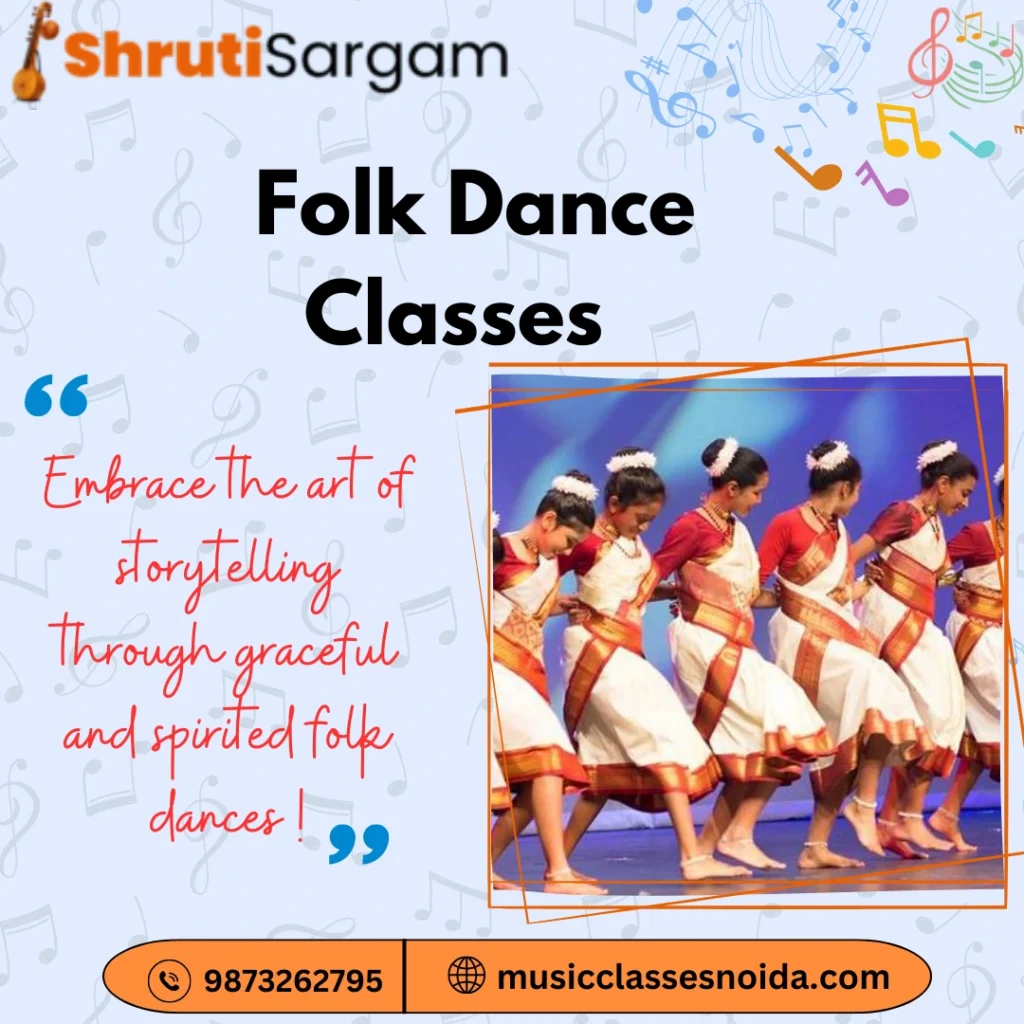
Folk dance is a dance that depicts the life of a particular country or region’s people. Folk dances are not all ethnic dances. Ritual dances or dances of ritual origin, for example, are not considered folk dances. Ritual dances are commonly referred to as “religious dances” due to their purpose.
When it is necessary to emphasise the cultural roots of the dance, the terms “ethnic” and “traditional” are used. Almost all folk dances are ethnic in this sense. Although some dances, such as polka, cross ethnic boundaries and even the line between “folk” and “ballroom dance,” ethnic differences are often significant enough to be mentioned.
In India, folk dances represent the culture and tradition of the community from which they originated. Folk dances are typically performed at community celebrations such as childbirth, festivals, and weddings.
Highlights
| Fact | Description |
| Origins | Folk dance is an important part of the cultural heritage of many countries around the world, including India, Mexico, and Ireland. |
| Styles | There are many different styles of folk dance, each with its own unique history, music, and movements. Some popular styles include Bhangra, Garba, Dandiya, Flamenco, and Irish step dance. |
| Benefits | Folk dance is a great way to stay active, improve coordination, and build endurance. It also helps to promote cultural awareness and can be a great way to make new friends and connect with people from different backgrounds. |
| Costumes | Many folk dances are performed in traditional costumes that are designed to reflect the history and culture of the dance. These costumes can be colorful, intricate, and beautiful, and are often an important part of the performance. |
| Instruments | Many folk dances are accompanied by traditional musical instruments, such as drums, flutes, and accordions. The music is an important part of the dance and helps to create a lively and energetic atmosphere. |
Types of Indian Folk Dance
| State | Folk Dance Form |
| Andhra Pradesh | Vilasini Natyam, Bhamakalpam, Veeranatyam, Dappu, Tappeta Gullu, Lambadi, Dhimsa, Kolattam. |
| Arunachal Pradesh | Buiya, Chalo, Wancho, Pasi Kongki, Ponung, Popir |
| Assam | Bihu, Bichhua, Natpuja, Maharas, Kaligopal, Bagurumba, Naga dance, Khel Gopal. |
| Bihar | Jata-Jatin, Bakho-Bakhain, Panwariya |
| Chhattisgarh | Gaur Maria, Panthi, Raut Nacha, Pandwani, Vedamati, Kapalik |
| Gujarat | Garba, Dandiya Raas, Tippani Juriun, Bhavai |
| Goa | Tarangamel, Koli, Dekhni, Fugdi, Shigmo, Ghode, Modni, Samayi nrutya, Jagar, Ranmale |
| Haryana | Jhumar, Phag, Daph, Dhamal, Loor, Gugga, Khor. |
| Himachal Pradesh | Rauf, Hikat, Mandjas, Kud Dandi Nach |
| Jharkhand | Alkap, Karma Munda, Agni, Jhumar, Janani Jhumar, Mardana Jhumar, Paika, Phagua |
| Karnataka | Yakshagana, Huttari, Suggi, Kunitha, Karga |
| Kerala | Ottam Thullal, Kaikottikali |
| Maharashtra | Lavani, Nakata, Koli, Lezim, Gafa, Dahikala Dasavtar |
| Madhya Pradesh | Jawara, Matki, Aada, Khada Nach, Phulpati, Grida Dance, Selalarki, Selabhadoni |
| Manipur | Dol Cholam, Thang Ta, Lai Haraoba, Pung Cholom |
| Meghalaya | Ka Shad Suk Mynsiem, Nongkrem, Laho |
| Mizoram | Cheraw Dance, Khuallam, Chailam, Sawlakin, Chawnglaizawn, Zangtalam |
| Nagaland | Rangma, Zeliang, Nsuirolians, Gethinglim |
| Odisha | Savari, Ghumara, Painka, Munari |
| Punjab | Bhangra, Giddha, Daff, Dhaman, Bhand |
| Rajasthan | Ghumar, Chakri, Ganagor, Jhulan Leela, Jhuma, Suisini, Ghapal |
| Sikkim | Chu Faat, Sikmari, Singhi Chaam or the Snow Lion, Yak Chaam, Denzong Gnenha, Tashi Yangku |
| Tamil Nadu | Kumi, Kolattam, Kavadi |
| Tripura | Hojagiri |
| Uttar Pradesh | Nautanki, Raslila, Kajri, Jhora, Chappeli |
| Uttarakhand | Garhwali, Kumayuni, Kajari, Jhora, Raslila |
Popular Folk Dance of India
When it comes to Indian culture, the Folk Dances of India, each one unique, are a study. These dances are so well-known that they are frequently regarded as “representatives” of the states from which they originate.
Bhangra Dance From Punjab: The Bhangra is a highly energetic, colourful, and joy-inducing dance known for its rhythm, style, rich, special clothes, vigour, and happiness. Several dancers perform vigorous kicks, leaps, and bends of the body—often with upraised, thrusting arm or shoulder movements—to the accompaniment of short boliyan songs and, most importantly, to the beat of a dhol (double-headed drum).
Lavani Dance From Maharashtra: Lavani is a popular music genre in Maharashtra, India. Lavani is a traditional song and dance that is performed to the beats of the Dholki, a percussion instrument. Lavani is known for its strong rhythm. Lavani has made significant contributions to the growth of Marathi folk theatre.
Garba Dance From Gujarat: Garba is a type of Gujarati dance that originated in the Indian state of Gujarat. The name comes from the Sanskrit word Garbha. Many traditional garbas are held in the presence of a centrally lit lamp or a picture or statue of the Goddess Shakti. It is traditionally performed during the nine-day Indian festival of Navartr. As an object of veneration, either the lamp (the Garba Deep) or an image of the Goddess Durga (also known as Amba) is placed in the centre of concentric rings.
Chhau Dance From Bengal, Orissa & Bihar: Chhau dance, also spelled Chhou dance, is an Indian semi-classical dance with martial and folk traditions. [1] It is performed in three styles, each named after the state in which it is performed: Mayurbhanj Chhau in Odisha, Seraikella Chhau in Jharkhand, and Purulia Chhau in West Bengal.
The dance ranges from a festive folk dance celebrating martial arts, acrobatics, and athletics to a structured dance with religious themes found in Shaivism, Shaktism, and Vaishnavism.
Job Prospects & Career Opportunities
Folk dance is not only a fascinating cultural pursuit, but it can also lead to a variety of job prospects and career opportunities. Here are a few examples:
- Performer: As a folk dance performer, you could perform at festivals, concerts, and cultural events. You could also perform in stage productions, movies, and television shows.
- Choreographer: With experience and training, you could become a folk dance choreographer. You would be responsible for creating and teaching dance routines to others, including performers and dance troupes.
- Dance Teacher: With a teaching certification or degree, you could become a dance teacher and instruct others in folk dance techniques and styles.
- Cultural Educator: You could also become a cultural educator, sharing your knowledge and expertise in folk dance and the cultural history behind it with others.
- Event Planner: As an event planner, you could organize and plan cultural events and festivals that include folk dance performances.
- Musician: Many folk dances are accompanied by live music, so if you have musical talent, you could pursue a career as a folk musician.
- Researcher: If you have a passion for cultural history and folklore, you could become a researcher, studying the history and origins of different folk dances and their cultural significance.
Folk Dance Classes in Noida
If you’re interested in learning how to perform folk dances, there are plenty of classes available in Noida to help you get started. These classes are designed to teach students the basic steps and techniques of various folk dances, such as Bhangra, Garba, Dandiya, and more. They are also a great way to meet new people and make friends who share your love of dance.
One of the best places to take folk dance classes in Noida is at Shruti Sargam Sangit Mahavidyalaya. Their experienced instructors are passionate about Indian culture and are committed to teaching students the art of folk dance. They offer a range of classes for students of all ages and skill levels, from beginner to advanced. Whether you’re looking to learn a specific type of folk dance or simply want to explore the beauty and richness of Indian culture, Shruti Sargam Sangit Mahavidyalaya is the perfect place to start. So why wait? Sign up for folk dance classes in Noida today and start your journey towards becoming a skilled dancer!
About Shruti Sargam
Shruti Sargam Sangit Mahavidyalaya, Dance & Musical Classes in Greater Noida (Affiliated to Prayag Sangit Samiti Prayagraj Regd.no. UPD 551) is one of the top music & dance schools in India and Delhi NCR, offers short term certificate level hobby course classes in dance and music, especially designed with a modern approach for teaching music and dance to kids, children and young adults, school and college students and for Television reality music show / competition participants.
Shruti Sargam is an initiative that teaches and promotes talented Indian musicians and dancers in order to help them build long-term careers. At Shruti Sargam, we teach music and dance in a holistic manner, allowing students to gain a deeper understanding of these intricate art forms.
Why Shruti Sargam?
We have a strong belief in each student’s individual learning process. Some people learn better when they work together, while others benefit from one-on-one attention. Some students begin from scratch, while others benefit from prior experience.
Shruti Sargam teaches online/offline Folk Dance classes for beginners, intermediates, and advanced students, as well as percussion. The Folk Dance classes provided are detailed in scale, giving each mood and emotion a definition. They intend to teach not only dancing but also facial expressions.
Shruti Sargam is regarded as one of the best Folk dance classes in Noida and Delhi, providing professional practical and theoretical training in Folk dance and its associated disciplines with the goal of producing the next generation of professionals.
Our qualified and trained teachers have been practising and specialising in the individual art form for many years. We not only provide regular class sessions, but also opportunities for aspirants to demonstrate their skills.
To achieve this, we created an integrated Folk Dance training curriculum that allows students to learn in great depth and detail while also seeing natural connections between dance subject areas, making Folk learning more meaningful and effective.
How To Enroll?
If you are interested in enrolling in our course, please call our admission helpline at +91 9873262795 or fill out the form on our website and a specialist will contact you.
Skill development becomes easier at a professional music training center with expert teachers.
Frequently Asked Questions
Q. What is the purpose of Folk dance?
A. Dances are performed as part of cultural events, such as coming-of-age, marriage, birth, and death, as well as on special occasions such as welcoming guests to the village and summoning spirits.
Q. How many folk dances are there in India?
A. In India, there are over 30 different folk dances. Gidda, Bhangra, Ghoomer, Kacchi Gori Chari, and Kalbelia are some of the most popular folk dances from various Indian states.
Q. Who can learn Folk dance?
A. Every individual who have interest and wants to explore every state cultural dance form.
Q. What types of folk dance classes are offered in Noida?
A. Noida offers a variety of folk dance classes, including Bhangra, Garba, Dandiya, Rajasthani folk dance, and many more.
Q. Are there classes available for beginners?
A. Yes, many folk dance classes in Noida cater to beginners, and they will start with basic steps and gradually build up to more complex movements.
Q. Do I need any prior experience in dance to take folk dance classes?
A. No, prior dance experience is not required to take folk dance classes. The classes are designed for beginners and cater to all levels of experience.
Q. Is there any age limit for taking folk dance classes in Noida?
A. No, there is no age limit for taking folk dance classes in Noida. Classes are available for all age groups, from children to seniors.
Q. Where can I find the best folk dance classes in Noida?
A. There are many institutes and academies in Noida that offer folk dance classes, but Shruti Sargam Sangit Mahavidyalaya is one of the best institutes for folk dance classes in Noida.